
Kevin Quinn: IRONMAN Japan
South Hokkaido, 13 September 2026
 What started as a vague, wishful idea over twelve months turned into a commitment after a post-race session in the Depeche Mode bar in Tallinn Old Town. Someone nameless renamed the Tallinn group chat “Japan Ironman.” Thus the Road to Japan was born.
 What started as a vague, wishful idea over twelve months turned into a commitment after a post-race session in the Depeche Mode bar in Tallinn Old Town. Someone nameless renamed the Tallinn group chat “Japan Ironman.” Thus the Road to Japan was born.
Over the next six months that nugget became a three-week trip, including 600 km through Korea from Seoul to Busan — which may get its own write-up. This one is the race.
IRONMAN Hokkaido is the third edition since the brand came back to Japan: Hakodate, on the northern island, about 700 km north of Tokyo.
A taper, of sorts
 After eight days in Korea we took an overnight ferry to Fukuoka and began a “taper week” travelling up through Japan. That included an 80 km ride over the Shimanami Kaido — spectacular — another overnight ferry to Osaka, one night there, then the Shinkansen to Tokyo. Not a standard taper by any measure. Fabulous, though. I was falling in love with Japan. The people are so friendly and helpful.
Two nights in Tokyo, including snake sake, purely for its health benefits. Then the Shinkansen north to Hakodate, currently the end of the line. It is a four-hour journey, so I upgraded to the Green Car. Travelling by train with a bike means a rinko bag and booked seats with extra storage.
A nap on the train, a taxi to the hotel. Lovely place: kitchenette, washing machine — gold after two weeks on the road — plus pyjamas and slippers for the hotel and the onsen. Hakodate felt a world away from Osaka and Tokyo. Incredible steak nearby, then the onsen. Once you get past the business of washing and being naked in a communal room, they are fantastic.
Friday — check-in
 Breakfast was the real thing: fresh fish, raw and cooked, and a spread that knocks a standard hotel buffet into a cocked hat. I rebuilt the bike and rode to the stadium to have a look. The local roads are rougher than further south — winters will do that — but drivers were courteous, and everyone actually stops at crossings.
Check-in was smooth. Staff were helpful and clearly pleased people had come from abroad. While a young lad fitted my wristband with great care, I shouted “ow.” His colleagues fell about.
The expo was small. I bought a few T-shirts and a tri-belt, then found out they had already put one in the race pack. I skipped the briefing. Wish I hadn’t — I missed the wooden M-dot. The whole thing felt quieter than Tallinn, but warmer. I got a selfie with triple Olympian Ai Ueda, the race ambassador: a genuinely happy person. Short swim near the hotel that afternoon. Water lovely, air noticeably cooler than further south, sun out.
Saturday — racking
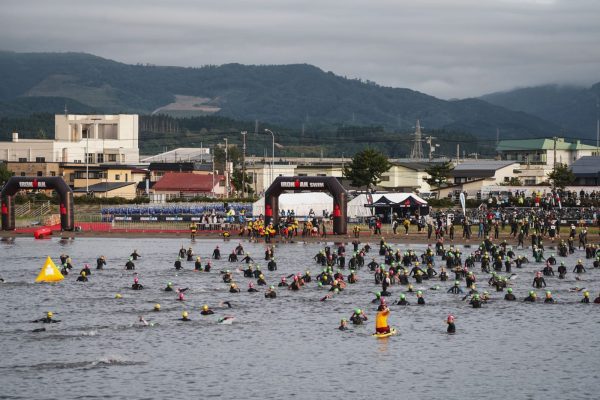 The race is based in Hakodate and spread all over it. Swim and T1 sit about 12 km away. There was a shuttle; I rode out with my kit. I had left the wetsuit and cycling shoes at home after all the travel, so there was less to carry. Busier roads, retail and industrial, still felt safe.
Bike racked, then a quick test swim. The course sits next to a fishery, so swimming is tightly limited — two people had been kicked out the day before. The no-wetsuit gamble looked right: water around 22°C.
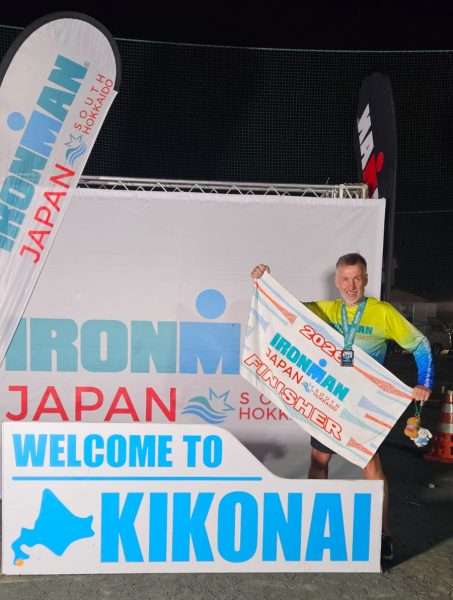
Shuttle on to T2 in Kikonai, another 34 km down the coast, finish in the same town. Dropping the run bag was a formality. I was riding in running shoes on flat pedals. Sleepy seaside place, nicely so. We skipped the shuttle back and took the local train: the opposite of the Shinkansen, museum-piece rolling stock, still spotless.
Roy, who had ridden and travelled through Korea and Japan with us, arrived from a couple of days at Mount Fuji. The other four had flown home. Six of us had bonded over one of the best trips any of us had done.
Steak restaurant again. Then the onsen. Then an attempt at sleep.
Race day
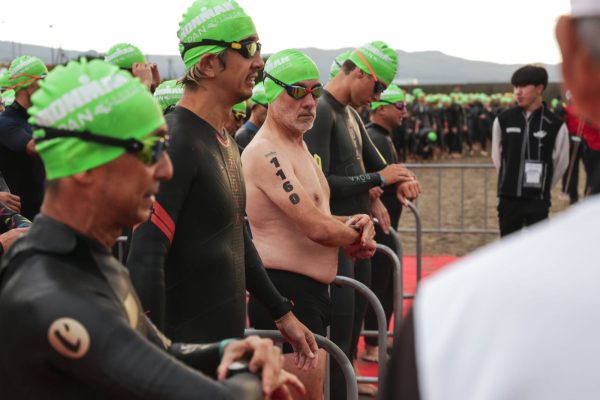 Awake before the alarm after a few short, fitful hours. Cold coffee, eggs and crab from the convenience store — Japanese canned coffee is fantastic — then the shuttle. I sat with a Canadian doctor on his 18th Ironman. What’s with doctors?
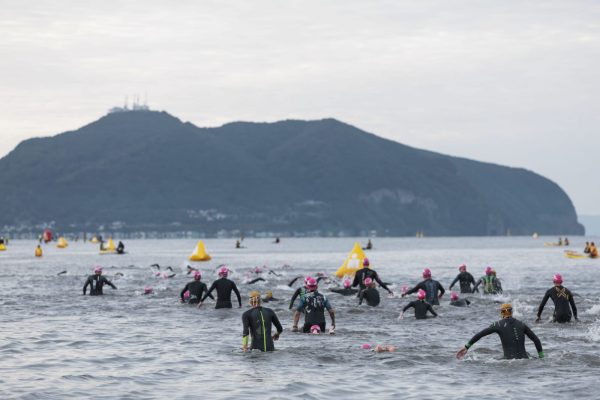
An hour of faff and trying to relax in T1, with a proper rising sun over the bay. Into the pods. I seemed to be the only person in true skins; I had decided not to swim in the trisuit. Water 22.9°C, shallow at first. I swam as soon as I could while others were still wading.
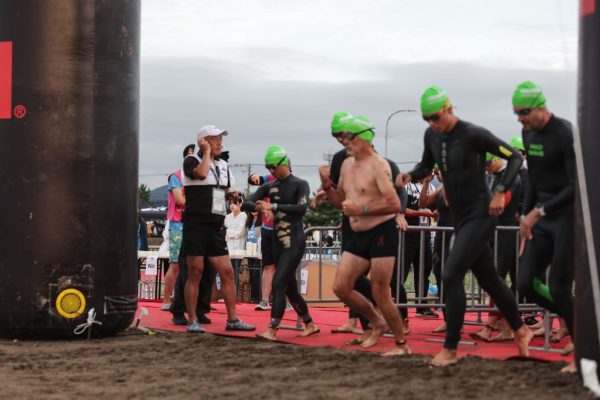 The course is three legs — 800 m, 300 m, 800 m — times two, Aussie exit after lap one. Someone called my name between laps for being in skins, which was cool. Lap two went as well as lap one. Watch glance at the beach: happy enough. The usual tax for no rubber.
Swim 1:27:37 · M60–64 39/80
T1 7:46 — tent, sand off the feet, no rush. About ten weeks earlier I had sliced my leg open and needed five stitches. The trip had nearly ended there. After that, the clock mattered less.
The bike — tunnels in more than one sense
I felt great off the mount and tried to keep it steady. Up onto the highway toward Kikonai, two tunnels, one of them 2.5 km. Rolling, one steep climb each lap, a few long grinds.
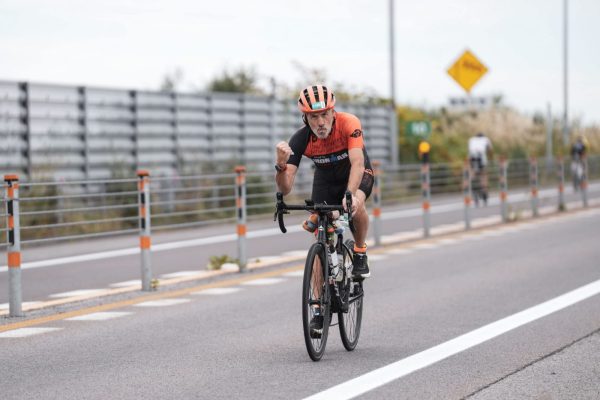 Pace was on a par with Tallinn last year despite the different profile. Green hills, the odd sea view. At halfway I still felt good and ahead of what I had hoped. Comfortable. Then a different sort of tunnel.
The head went. Around 110 km the tunnel vision arrived properly, with the usual dark thoughts and a mental list of excuses. I was staring at the road when someone shouted my name. Roy, in a spectator pocket. That was enough to drag me to the next aid station.
Toilet stop, a gel, fluids. About eight minutes off the bike. Legs had been fine the whole time, which was the weird part. I eased back, drank on a schedule, poured water over myself, and about then the wind got up — long stretches into a headwind.
Head clearer, I just wanted T2. I was still, perversely, enjoying the day. Not many spectators, so I started shouting at the ones who were there. Last lap is shorter. Last time up the steep bit, last aid station, no turnaround this time — straight on, down into Kikonai, into T2. I was happy I had not got off.
Bike 7:21:13 · M60–64 49/80
T2 8:44 — the short-transition plan went out the window. Sat down, took a minute, put cream on.
The run — Oggy Oggy Oggy
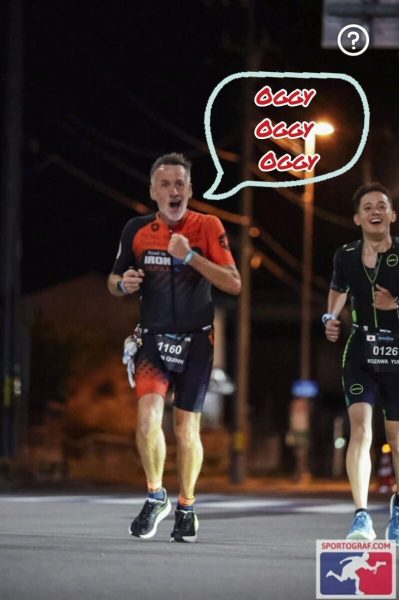 Toilet queue out of T2, then I started to tick along and the legs felt good. Plan: walk every aid station, run the bits between. Stations about 3 km apart. The run was the leg I had worried about. Training had taken the biggest hit from the injury; I felt undercooked. I was still picking people off, which helped.
The course is mostly flat with one short climb per lap, out into the countryside from Kikonai and very pretty. A few spectators on the lanes; the noise is in town around the finish. Aid-station crews were brilliant.
I spent a lap tick-tacking a young Japanese lad, passed him toward the end of lap one, then hit my personal needs bag: canned coffee, biltong, sweets. The coffee and the biltong were a godsend — different taste when everything else has gone sweet.
Then, from the roadside: “OGGY OGGY OGGY.” We had started that on the Cross Korea path, through the tunnels. Roy, with two Japanese spectators, all three of them at it. That lifted me properly. I caught the lad again. His legs were going. I dropped in beside him. His English was excellent. His name was Yuki.
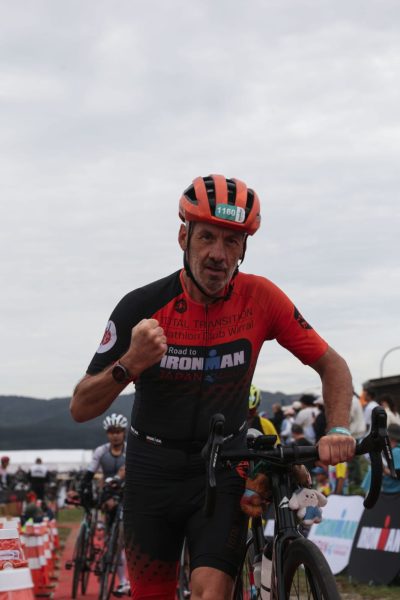 I suggested we run/walk it together. I started working the volunteers and the crowd, handing out high-fives the Japanese spectators were not quite expecting and then returned. I told Yuki about the Mario “power-up” signs in Europe, and how the interactions give you a lift. He followed the lead. End of lap two we were whooping at the barriers and getting it back. An American in the crowd told us it was good.
I had already explained Oggy to Yuki. We spotted Roy ahead and this time we got him first. A whole group came back with “Oi Oi Oi.”
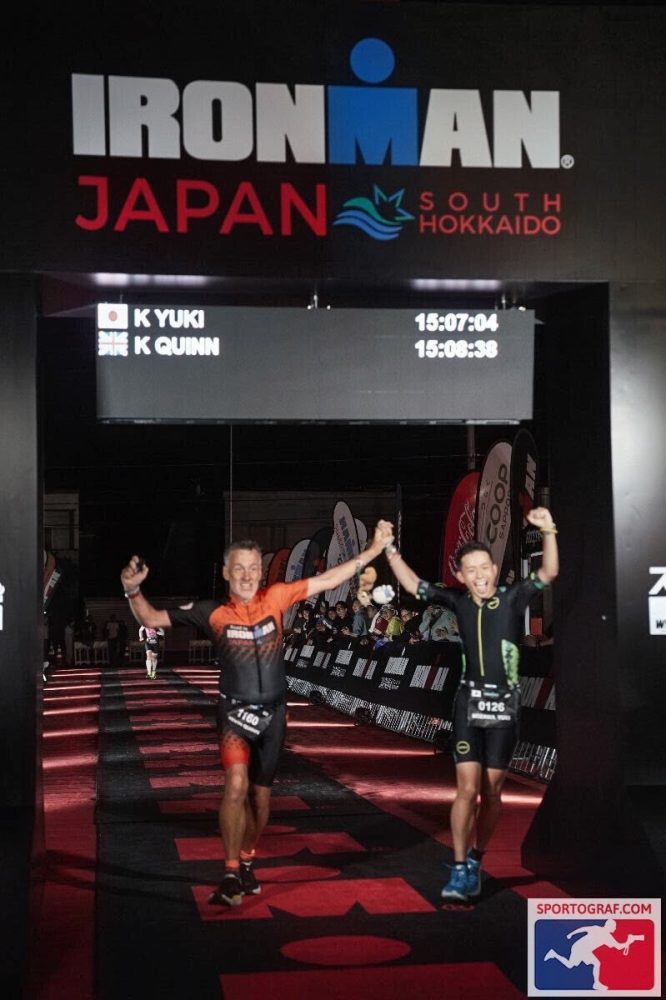
Lap three, the lack of run miles showed. It became a fast walk for three-quarters of the lap. On the edge of Kikonai I asked Yuki if we could cross together. He was in. Last kilometre we actually ran, looking better than we had any right to, feeding off the street. Red carpet, high-fives both sides, and we came together in the last few yards, hands up.
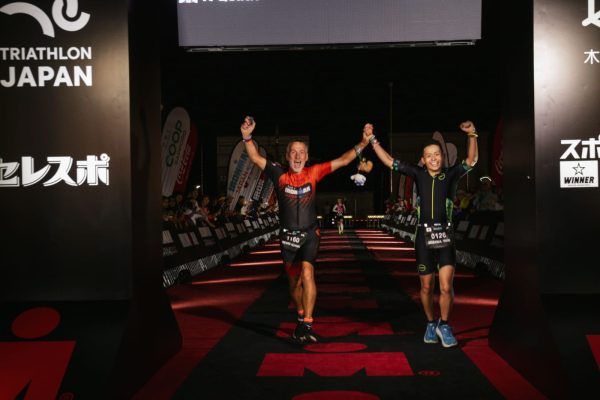 Crossing the line on Yuki’s first Ironman was the moment of the trip. New friendship, even if the little so-and-so beat me by just over a minute. I did not care.
Run 6:03:14 · M60–64 52nd
15:08:35 · M60–64 46th / 79 · 835th / 1,093
An unbelievable trip, capped properly.
